Scale of African slavery
revealed
By BBC News
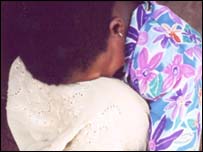
The trafficked
children can face terrible physical and emotional abuse |
Friday, 23 April, 2004—The
trafficking of human beings is a problem in every African country,
says the United Nations Children's Fund (Unicef).
The report, which covers 53 African nations,
says children are the biggest victims in what is a very complex
phenomenon.
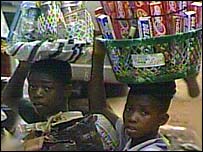
It describes how they are forced into slavery,
recruited as child soldiers or sold into prostitution.
In Africa, children are twice as likely
to be trafficked as women.
Trade
The BBC's Imogen Foulkes in Geneva says
the report found that 89% of the countries had trafficking to
and from neighbouring countries, but 34% also had a human trade
to Europe.
Poverty, traditional migration and conflict
are blamed for the traffic.
The trade in people is frequently regional.
Of the countries surveyed, 26% said trafficking
was taking place to the Middle East .
And the trade is often in both directions.
Nigeria, for example, has received trafficked
people from 12 African countries, but trafficked Nigerians have
been found in a dozen countries too.
Complicity
Much of this trade in children often has
the tacit collaboration of the victims' own families where it
is seen not so much as criminal activity but as a way for a large
family to boost its poor income.
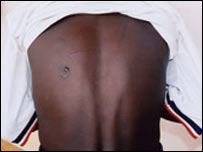
Joseph's back bears
the scars of his beatings
|
The story
of Joseph in Benin is fairly typical.
When he was 13 years old, a stranger arranged
with his parents for him to go to neighbouring Togo for a better
life.
However, he was put to work from 0500 to
2300 each day as a domestic help and was regularly beaten.
It took him three years of saving money
to be able to phone home and be rescued by an uncle. Now 16 years
old, he is back in school.
"I was so happy to see my little
brother again when I returned home to Benin ," he says.
Complexity
The report's director, Andrea Rossi, says
trafficking is a complex issue with many causes.
"Trafficking can start as slavery,
children and women are sold, but it can also start as a migration
process where children want to move.
"The only way they have to move
- because for example it's illegal, because you cannot move,
or it's difficult - the only option they have is to go through
trafficking patterns."
There are no reliable figures for just
how many people are trafficked in Africa , but it is likely to
run into the millions.
Unicef is presenting its report to a meeting
of African ministers in Benin .
The hope is to adopt an action plan to
combat trafficking, one which will place the rights of the child
at the centre of all future policy.