Tracking Africa 's
child trafficking
By BBC News
April 23, 2004 . Almost
all African states are affected by trafficking as importers
or exporters, or both, a United Nations Children's Fund
report says.
It also warns that children
are the biggest victims of trafficking: forced into slavery,
recruited as child soldiers or sold into prostitution.
BBC reporters in three countries
explore the illicit trade - from its origins in Africa to its
destinations in Europe .
Anna Borzello in Lagos , Nigeria
Thousands
of Nigerian children and young people are trafficked each
year, both within the country and beyond its borders.
No-one knows the scale of the problem,
but the International Labour Organisation
estimates at least 200,000 children
are trafficked within west Africa
annually. |
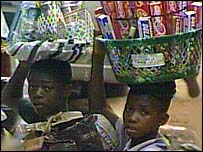
Nigeria's
'respectable' trade |
In the eastern
Nigerian city of Benin, girls and young women are sent to west
Africa and Europe to work as prostitutes.
Many go willingly, but some are tricked.
They are taken to a witch doctor, sworn
to secrecy and end up in effective slavery to the middle men
who smuggle them abroad.
Other children are trafficked for work
inside the country.
Girls and boys as young as six are taken
from desperately poor homes and placed as domestic workers with
strangers in the city.
In return, they are promised an education.
In reality, they are often beaten, fed on leftovers, forced to
work long hours and forbidden to go to school.
Other children are sent instead to work
in quarries or plantations, both inside Nigeria and in neighbouring
west African states.
Some are even trafficked for ritual
purposes and end up dead.
The Nigerian government has now recognised
the problem and last year outlawed trafficking and set up an
agency to deal with offenders.
But they have a difficult task ahead.
Close to 70% of the population live in poverty and traditional
values have been eroded by years of misrule.
For many Nigerians, trafficking has
become an accepted way of life.
Pascale Harter from Rabat,
Morocco
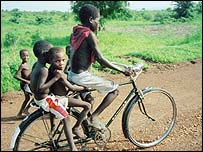
There are still children being
born into slavery in Africa |
In Morocco and in neighbouring Mauritania
women and children are often treated as commodities.
While reporting from Mauritania , I
met a runaway slave who told me she had been raped by the men
of her master's family.
Her children are still in his custody,
born into slavery just as she and her mother was before her.
Slavery was officially abolished in
Mauritania in the 1980s, but local associations say many families
still have slaves, who they sometimes send to business associates
to work off a debt.
Now in her late 20s, the runaway slave
I spoke to had started working for her master as soon as she
was old enough to carry water and clean.
But she has never earned a day's pay.
In Morocco the problem is different.
Here many children are born into poverty.
Abandoned by their husbands and unable
to find work, women are forced to send their children from the
age of five to be apprentices to tailors or carpet weavers, where
at least they will be fed.
At the port of Casablanca , Moroccan
children as young as seven can be seen running behind trucks
carrying goods to Europe .
They jump on to the back of the trucks
and hide there. Despite the danger of the journey, they often
leave with the consent of their parents who are simply to poor
to provide for them.
Frances Kennedy from Rome,
Italy
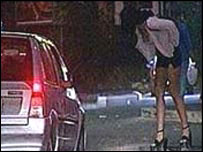
Many African girls are lured
abroad by false offers of jobs |
Many of the African girls and women
who are trafficked to Europe end up on the streets.
Italy is one of their prime destinations.
There are tens of thousands of foreign prostitutes on Italian
streets - many of them African and particularly Nigerian, and
some just girls.
Promises of jobs as babysitters or waitresses
evaporate as the women arrive and are put to work.
In the suburbs of main cities and on
provincial highways, rain or shine, scantily-clad African women
are on sale.
Italian men like them because they are
inexpensive and obliging.
They are closely
controlled by a "maman",
an older woman, and those who fail to earn enough are punished
with violence.
They are deprived of their passports
and some of them are held as virtual prisoners.
Programmes to encourage African girls
out of prostitution have had little success for several reasons:
- their exploiters threaten to harm
their families back in Africa
- the women are convinced through voodoo-type
rituals that their own lives will be at risk if they break
free
they worry they won't be able to find
legal work to keep supporting their relatives back home.