|
Ozier Muhammad/The New York
Times
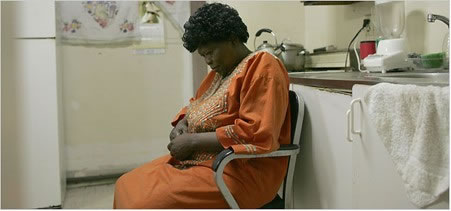
Martina Okeke, 68, says that she was fooled into coming to
America as a servant by a family on Staten Island that refused
for 12 years to pay her.
|
April
24, 2007—Martina
Okeke lives in a dark basement in Queens that reeks of some mystery
odor. She earns $100 a week caring for a cherubic toddler. She
ekes out a few more dollars pushing a battered shopping cart
through the streets of South Jamaica, filling it with cans and
bottles she plucks from the garbage and cashes in for the deposits.
Welcome to America.
“It’s not easy,” she
said with a shrug. “Yeah, but what can I do?”
She is used to doing whatever she must
to survive. Born 68 years ago in Nigeria,
she has been a seamstress, a trader and even a farmer. She said
that in 1988, widowed and with two children to support, she agreed
to come to the United States to cook, clean and care for the
children of a Nigerian couple living in Staten Island. She said
they promised to pay her $300 a month. There were promises of
a house and tuition, she added, for her two children back home.
|
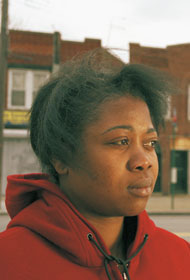
Ozier Muhammad/The New York
Times
Beatrice Okezie, 30, spent nine years enslaved by a Bronx
couple, who were convicted on federal charges. She now helps
similar victims.
|
She admits now that she toiled 12 years
for a paycheck that never came. Not one cent.
Encouraged by friends from her church,
she worked up the courage to leave the family in 2000. Still,
she refused to report the family to the authorities.
“I did not want to have a bad name,” she
said, in the basement that is her home in freedom. “That
somebody took me from Nigeria to America and I made trouble for
them. I know my people. They would say I went to America to make
trouble. That would not be good for me.”
Fear keeps victims of human trafficking
in shadows.
This is not uncommon, said advocates
for victims of human trafficking. Fear, uncertainty and cultural
taboos make it hard for women like Ms. Okeke to speak out. Although
human trafficking has been a federal crime since 2000, efforts
in the New York State Assembly to criminalize human trafficking
and provide services for its victims have yet to succeed while
advocates and politicians struggle to reconcile competing concerns
over punishment and assistance.
“It’s amazing that we have
not passed a law,” said Assemblyman Jeffrey Dinowitz, who
started working on such a bill three years ago to enable local
police departments and prosecutors to go after offenders. “For
the most part, victims of human trafficking are not your typical
poster child, so there is no urgency. And one of the biggest
challenges is the victims are afraid to come forward, since there
are so many burdens placed on them.”
Although politicians — especially
at the federal level — inveigh against human trafficking
as a crime that enslaves thousands of people, especially women
forced into prostitution, policy experts said there were no reliable
figures on the extent of the problem. The federal government
cites a figure of up to 800,000 people being trafficked internationally,
with more than 14,000 of those entering this country.
But those figures
were criticized as flawed in a report issued last year by the
Government Accountability Office, an investigative arm of Congress,
which concluded that the government actually had no “effective mechanism” for
estimating victims.
In what is believed to be the first effort
of its kind in the nation, the nonprofit Vera Institute of Justice
has begun a research project in New York City to develop better
methods of identifying and counting victims of human trafficking.
In the absence of reliable figures, prosecutors
and policy makers said, human trafficking is often cast in terms
of the global sex trade, partly because there are more systematic
methods like raids on brothels to root out its victims, as well
as advocacy groups helping them.
“A lot of claims have been made
by various agencies of the U.S. Government, lobbyists and activists
that sex trafficking is the bigger problem, but there is no evidence
to support that,” said one policy expert who spoke on condition
of anonymity in order not to jeopardize relationships with advocacy
groups and government officials. “And I am not sure that
having the numbers will help the claims people have been trying
to make.”
One federal prosecutor who has successfully
brought cases against traffickers in the city said that people
forced into labor as factory workers or domestic help might be
more the norm than people would think. But they are also hard
to root out because they are out of sight and isolated from the
public.
Ms. Okeke said she spent her 12 years
living in the basement of a house on a dead-end street on the
north shore of Staten Island. In 1988, she said, a relative of
Marco and Grace Mbadiwe approached her in her village with the
promise of work in the United States. She accepted, expecting
to be paid $300 a month.
What followed upon her arrival, she said,
was two years of cooking, cleaning and baby-sitting without a
day off. Only after she protested, she said, was she given Sundays
off.
But no matter how many times she asked,
she said, the Mbadiwes never paid her.
“They paid me nothing,” she
said. “Every time I asked they said when I was ready to
go back to Nigeria they would do something. I did not say anything
against them. When I saw I received no pay, nothing, I told them, ‘I
want to go, so pay me.’ They said I had to wait until I
reached Nigeria.”
The Mbadiwes
are divorced and did not respond to separate and repeated requests
made in person, in writing and by phone for comment. Grace
Mbadiwe, who now operates a day care center in her home, would
reply only, “I have
nothing to say about it” when asked in detail about Ms.
Okeke’s claims.
Since leaving the family in 2000, Ms.
Okeke has been helped with food and housing by a man from her
village who gave her the basement apartment, which she shares
with another woman. She has also sought immigration help from
Africans in America, a group that was established six years ago
to assist others who found themselves through force or fraud
living in servitude.
Bonaventure Ezekwenna runs the group
along with his wife, Beatrice Okezie, who herself spent nine
years enslaved by a Bronx couple, who were eventually convicted
on federal charges and sentenced to more than 10 years each.
Through fliers and word of mouth, Africans in America tries to
spread its message to others who may still be in servitude.
The group knows
the lure of this country remains strong. “There is really crushing poverty back
home, and everybody wants to run away from it,” Mr. Ezekwenna
said. “When the trafficker comes, all he has to do is say
they are taking them to America or Europe. That is synonymous
with having a better life. How do you convince them? It is not
hard.”
Ms. Okeke certainly
found no golden door awaiting her when she arrived in this
country. For now, she will settle for the battered gray metal
door that leads to her basement home, where toddler toys clutter
the room. She has not seen her own children — now adults — since
1988.
“They said they need my help,” she
said of a recent letter from one of her children. “They
are suffering.”
If she had the money, she would like
to go visit them. Then she would come right back to New York,
to the apartment where the cabinet doors hang off kilter, sunlight
barely reaches and calendars teasingly depict smiling tykes and
fetching women.
“This
is rich compared to Nigeria,” she
said. “Nigeria before was good. Now, it is like hellfire.”