Nigerian female
victim of human trafficking
locked up in INS detention in Houston, Texas battles
for freedom
March 30,
2007—Ms. Celestina
Ifeacho Joseph, a Nigerian victim of human trafficking facing
deportation in INS detention in Houston, Texas has made a desperate
appeal for help from the United States government and the public.
Speaking during a live interview on
KPFT radio ( )
Haiti Show broadcast from Houston, Texas on March 25, 2007,
7.30 p.m. the victim narrated her gruesome ordeal at the hands
of Houston based Nigerian brutal human traffickers and their
associates and made emotionally desperate appeal for support
in her quest for thorough investigation of her story by the
government of United States. )
Haiti Show broadcast from Houston, Texas on March 25, 2007,
7.30 p.m. the victim narrated her gruesome ordeal at the hands
of Houston based Nigerian brutal human traffickers and their
associates and made emotionally desperate appeal for support
in her quest for thorough investigation of her story by the
government of United States.
Background information
Africans In America News Watch investigation
reveals that the victim (Ms. Celestina Ifeacho Joseph) as a
poor girl from abject poverty situation in Nigeria was allegedly
recruited and trafficked from Nigeria into Houston, Texas in
1984 at the tender age of 10.
|
|
|
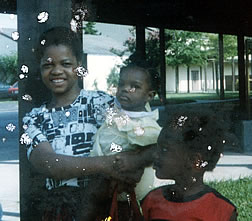
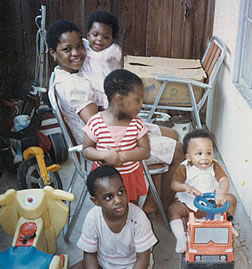
Celestina
as little girl shown at work in the household of her
alleged trafficker in early 1980s in Houston, Texas |
Upon arrival
in Houston, she allegedly worked for the Nigerian traffickers
in various locations for over 15 years without pay. The locations
were; 1) Victim worked in their house as household maid doing
house chores, cooking, cleaning and babysitting her traffickers’ 4
children as well as children of their associates; 2) Victim
worker in their restaurant as cook, waitress, dishwasher,
etc; and 3) Victim worked in elderly care business (group
home, assisted living for the elderly and sick) owned by
the traffickers.
|
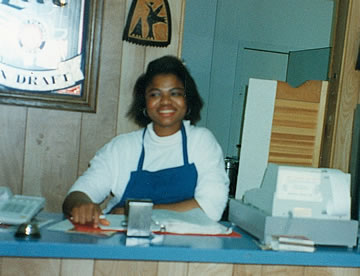
Celestina
as grown woman shown at work in the business of her alleged
trafficker in early 1990s in Houston, Texas. |
She allegedly suffered horrendously
painful and dehumanizing and inhuman battery of sexual torture,
including excruciating physical and emotional torture details
of which are too gory and graphic for print for over 15 years.
She allegedly escaped from her traffickers in 1999.
Though she is currently 33 years
old and had been in United States for 23, she remain undocumented
because her traffickers allowed her papers to expire and
did not bother to renew it. Her knowledge of the how the
system works in United States is severely limited due to
lack of formal education, lack of appropriate exposure, fear
and intimidation, compromisingly coerced socialization processes,
among other factors.
Lies, cover-up and obstruction
of justice
Africans In America News Watch investigation
reveals that due to fear, intimidation and ignorance, victim
Celestina was too scared to open up and tell her full story initially
when she came in contact with the U.S. immigration department
(INS agents). She allegedly went through some convoluted marriage
process, details of which is not so clear yet, but she was still
too terrified of her traffickers to disclose her full ordeal
to the U.S. authorities. She was subsequently arrested by the
INS and placed on deportation.
|
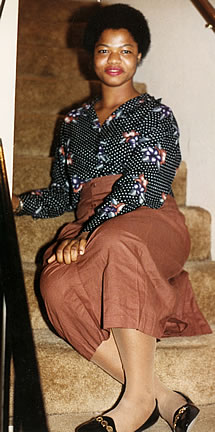
Celestina
as grown woman shown in the residence of her alleged trafficker
in early 1990s in Houston, Texas. |
Faced with
possibility of deportation to Nigeria where she may be at the
mercy of her traffickers’ wraths
since she has belatedly started to open up on her horrendous
ordeals, she had consequently, though belated as well, decided
to cried out for help.
The victim is requesting for 2 things,
namely;
1. Help
in securing trustworthy and professional legal representation,
and
2. Help in convincing the U. S. government
to give her another opportunity to tell her full story (thorough investigation
of her story) with view to certify her as a victim of severe form of trafficking-in-person.
Africans In America News Watch investigation
reveals, however, that there are serious questions about the
quality of legal representation this victim had when she came
in contact with the INS.
The circumstances leading to the victim's
arrest and deportation proceedings by INS appear complex, however,
what appears clearly disturbing is the report that one of the
attorneys that had represented her was secured and provided to
her by the trafficker and may have been friend or associate of
the traffickers.
Consequently,
the facts and circumstances of victim’s situation were not truly made known to the
United States authorities and the courts. In a nutshell, the
poor and naïve victim apparently never had a real legal
representation. The attorney was there to protect the trafficker’s
interest and not the victim’s, according to the victim
and her supporters.
More alarming is the allegation that
the lawyer who is representing her is a Nigerian immigrant who
may be sympathetic to the trafficker, therefore raising the clear
possibility of cover-up and obstruction of justice, among others.
Example; the
victim complaint about the Nigerian immigration attorney include
a presentation he allegedly submitted informing the court that
the victim’s trafficker
had passed away. The victim punched holes on this misleading
claim by stating that her trafficker is alive and lives in Houston,
Texas. The victim only belatedly fired the attorney after she
was arrested by INS and put in detention. By then the damage
had been done.
Other criminal activities
The victim stated that she had witnessed
other criminal activities perfected by her traffickers and their
associates, which she has indicated willingness to disclose to
the authorities, now that she is facing deportation.
Africans In
America News Watch investigation reveals that effort to intimidate
the victim may have begun. Our investigation reveals that the
associates of the traffickers may have visited the victim in
detention to warn her never to disclose certain ‘incriminating information’ she
may have about their activities.
Community outrage
Now that victim
is facing deportation, she and few members of the Nigerian
community in Houston including medical professionals, social
workers and community leaders that know her case very well
are now outraged at the poor victim’s
ordeal and may have also belatedly decided to save her.
Recently, a Houston based Nigerian immigrant
human rights advocate/activist Chief Eric Ufom, President of
Equal Rights for Persons with Disabilities International, Inc,
and Joint National Association of Persons with Disabilities of
Nigerian in the Diaspora contacted a New York-based Africans
In America, Inc. (AIA), a leading human rights organization addressing
social issues concerning the larger African community in United
States. This organization is championing the African community
efforts to advocate services to Africans victims of human trafficking
that are largely ignored, un-served, underserved and sidelined
in the distribution of resources. Both organizations have commenced
high-level, as well as grassroots effort to save this victim.
It is unknown whether the pressure will
be enough to convince the INS to put her deportation on hold
and reopen investigation.
Human rights advocates and other supporters
are hoping that the authorities take into account the circumstances
of this victim and reconsider her case. Meanwhile, time may be
running out since the INS agents had reportedly informed her
to get ready for deportation any moment from now.
Sadly though, the poor victim in this
case, like other victims in other cases across the country is
not getting overwhelming support from her community. Sadly, the
African community in general has embarrassing habits of supporting
the more affluent traffickers and help to further oppress and
suppress the poor and the weak. Very sad, indeed.
Implication in the battle against
human trafficking
Africans In
America News Watch investigation reveals that there are many
cases such as Celestina’s scattered
allover the place within the African communities in United States.
Many African victims of human trafficking
stranded in the United States are generally too terrified to
come forward for fear of arrest by INS for expired documents,
fictitious documents and fictitious names of the expired documents,
lack of fund to hire an attorney, lack of concrete support, fear
of whether the authority will investigate their story, among
other reasons. Africans victims of human trafficking are generally
very poor and rarely could they afford the high cost of quality
legal services in United States.
Human rights advocates and African community
leaders in United States are networking the authorities, insisting
that it is imperative that deportation of this victim be put
on hold to give the government the opportunity to thoroughly
and clinically investigate this case in view of new and unfolding
information.
Victims certified by U.S. government
may get protection of the law, some services including adjustment
of status, T visa and other government mandated benefits. Victims
may also pursue civil claim against their traffickers.
The African communities in United States,
especially, the Nigeria communities are closely watching this
case, which may have a far-reaching implication on the government
effort to combat human trafficking.
The other side of the story
Africans In America News Watch investigation
reveals that several individuals including a lady who identified
herself as the accused human trafficker have contacted Africans
In America, Inc. and presented entirely different picture of
the story. They stated that they never know the meaning of the
word human trafficking.
They denied all the allegations and added
that the victim was treated very well after she was brought to
United States on humanitarian ground. They added that they even
attempted to help her when she had this immigration problem.
They also blamed the whole problems on
the Houston based Nigerian immigrant human rights advocate Chief
Eric Ufom, President of Equal Rights for Persons with Disabilities
International, Inc, and Joint National Association of Persons
with Disabilities of Nigerian in the Diaspora and called him
all sorts of unprintable names, and raised very serious questions
about his personality, character, integrity, credibility and
motives.
They however, admitted that the victim
is one of their own, came to United States in 1984 at the age
of 10, worked for them, did not get formal education, is currently
in prison and facing deportation.
The Executive Director of Africans In
America, Bonaventure Ezekwenna encouraged the callers to put
their feelings towards anybody including Chief Eric Ufom aside
and work genuinely towards the freedom and justice for the victim
based on humanitarian grounds.
Mr. Ezekwenna, a vociferous human rights
activist reminded the callers to remember that we are in a society
(America) that frowns at gross injustice to the weak and protects
the weak. Mr. Ezekwenna reminded them that this lady in detention
in Houston, Texas is weak today, but when the system (the American
system, not Nigerian system) takes a very close look at her situation,
the bubble will burst and the community that abused her and those
that looked the other way will cry bitterly. Mr. Ezekwenna encouraged
them to do research and see how those kinds of cases were solved
in the past.
Mr. Ezekwenna indicated willingness to
be part of the solution, as far as justice to the victim is sincerely
paramount.
Unfortunately, none of the callers
was willing to make any commitment to work towards the freedom
of the victim from INS detention thereby fueling the suspicion
that they want her deported to conceal some ‘things.’
|